


Source-First vs. Topic-First: Two Ways to Watch a Market
In short
Topic-First fixes a topic and searches the whole web with it, who is speaking emerges only afterwards. Source-First fixes the sources and takes along every topic they speak about. Both are narrow, just in different places: Topic-First is open in its selection and narrow in its topic, Source-First narrow in its selection and open in its topic.
Why this is not a detail
Anyone choosing a market-monitoring tool usually compares features: which channels, which analyses, what price. But the difference that decides the value sits one level below, in the question of what is being filtered for in the first place.
That decision is made before the first item arrives, and it determines what you will systematically never see. No feature comparison makes up for it later.
The two approaches side by side
Both work with the same building blocks: there are speakers, and there is what they say. Only the selection logic differs, and with it, what ends up on your desk.
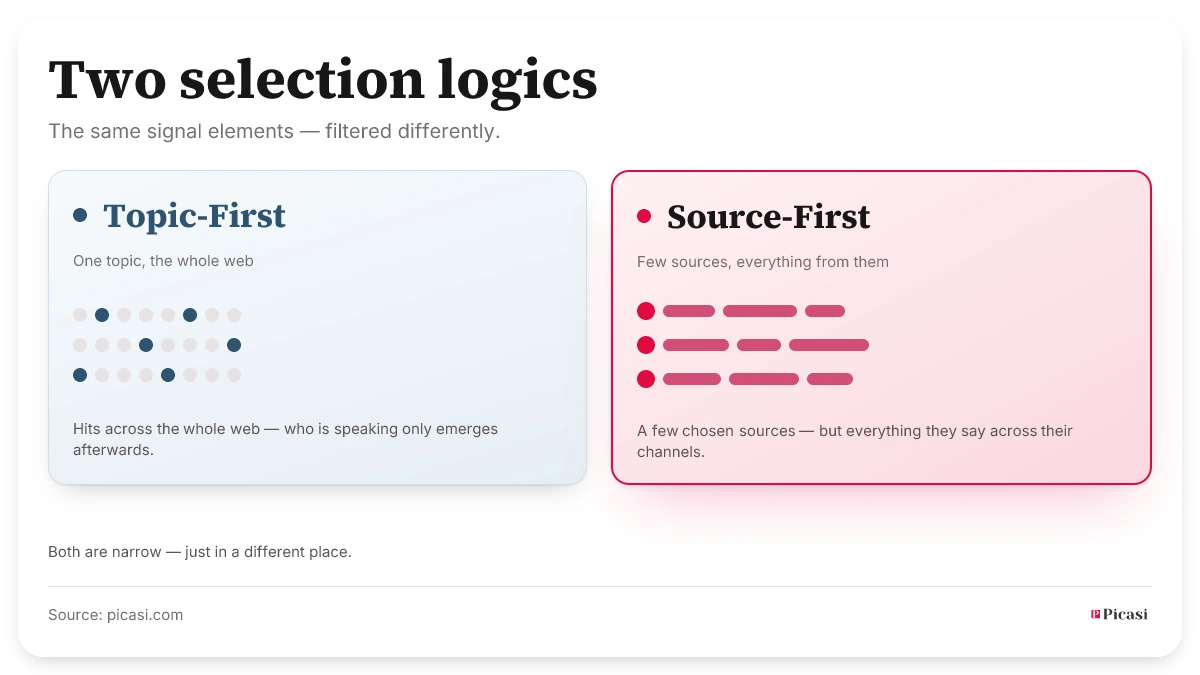
| Topic-First | Source-First | |
|---|---|---|
| Core question | “Where does my topic appear?” | “What are the people who matter saying?” |
| Kind of truth | Mention | Original statement |
| Selection | open, any sender can turn up | narrow, you choose the sources |
| Topic space | closed, only the defined topic | open, everything the source says |
| Typical place | search index, mention feeds | the source's own channels |
| The point | Open in selection, narrow in topic. | Narrow in selection, open in topic. |
What Topic-First does better
Topic-First has a strength that Source-First structurally lacks: it finds senders you do not know about. A start-up that has existed for six weeks and is already attacking you with your own vocabulary will not show up in a source-based approach, simply because nobody has put it on the list.
Where Topic-First is therefore the stronger choice:
- A technical term or a regulation is to be followed market-wide, regardless of who picks it up.
- You want to know whether your own product name is mentioned anywhere.
- The market is highly fragmented and the relevant senders change quickly.
Anyone with those questions is better served by classic keyword and mention monitoring than by Picasi. That is not modesty. it is a statement about the structure of the approach.
What Source-First does better
The advantage is the mirror image: you also learn the things you would never have searched for. When a monitored competitor suddenly starts talking about a topic that appeared in none of your search terms, a topic-based tool sees nothing, the item fits no pattern. A source-based one shows it, because the source is fixed rather than the topic.
Those are precisely the expensive moments in market monitoring. A change of position rarely announces itself in the words you have been searching for. It announces itself by someone starting to talk differently. I have heard this often enough in conversations with CMOs to take it seriously: the pivotal moment never came from a search term but from someone keeping an eye on that one source when it suddenly started speaking in a different tone.
There is also the reliability of attribution. With Topic-First, once you have a hit you still have to work out who is speaking and whether it counts. With Source-First that is settled in advance, whatever arrives comes from someone you deliberately chose. More on that in our piece on signal versus noise.
The price Source-First pays
It appears above, but it deserves its own paragraph because vendor texts usually leave it out: Source-First is blind to everyone not on the list. The quality of the result depends entirely on the quality of the source selection. A poorly maintained list reliably produces a wrong picture of the market, and a very tidy one, which makes it worse than obvious noise.
In practice: the source list is not a setup step but a recurring one. Anyone who compiles it once and does not look at it for three years is monitoring the market of the year before last.
Which approach when
A workable rule of thumb: can you name the market participants that matter?
If yes, five, ten, twenty names your team can list without thinking, then source selection is not a problem but your advantage. Source-First turns it into systematic monitoring.
If no, because your market consists of hundreds of interchangeable providers or turns over too quickly, then Topic-First is the more honest route. You accept mentions instead of original statements, and that the interpretation remains work.
And for many teams the right answer is both, with a clear division: Source-First for the market participants you can name, Topic-First as a net for everything coming from outside that list.
Which incompleteness you can afford
Choosing between Topic-First and Source-First is not a question of better or worse but of which incompleteness you are willing to accept. Topic-First gives up depth per sender, Source-First gives up breadth across unknown senders. Anyone using one without knowing the corresponding gap believes their market monitoring is more complete than it is.
Picasi sits deliberately on the Source-First side, track who, not what. In detail: What is Source-First Intelligence?
Frequently asked questions
See also
- The three approaches to market monitoring, the overview of all three ways
- Source-First vs. Platform-First, the third direction compared
- Source-First vs. Competitive Intelligence, what others say about you
- What is Source-First Intelligence?, the fundamentals
- Sources, Not Keywords, the detailed comparison with references, on source-first-intelligence.com