


Picasi Feature
AI Context: so the AI knows your company
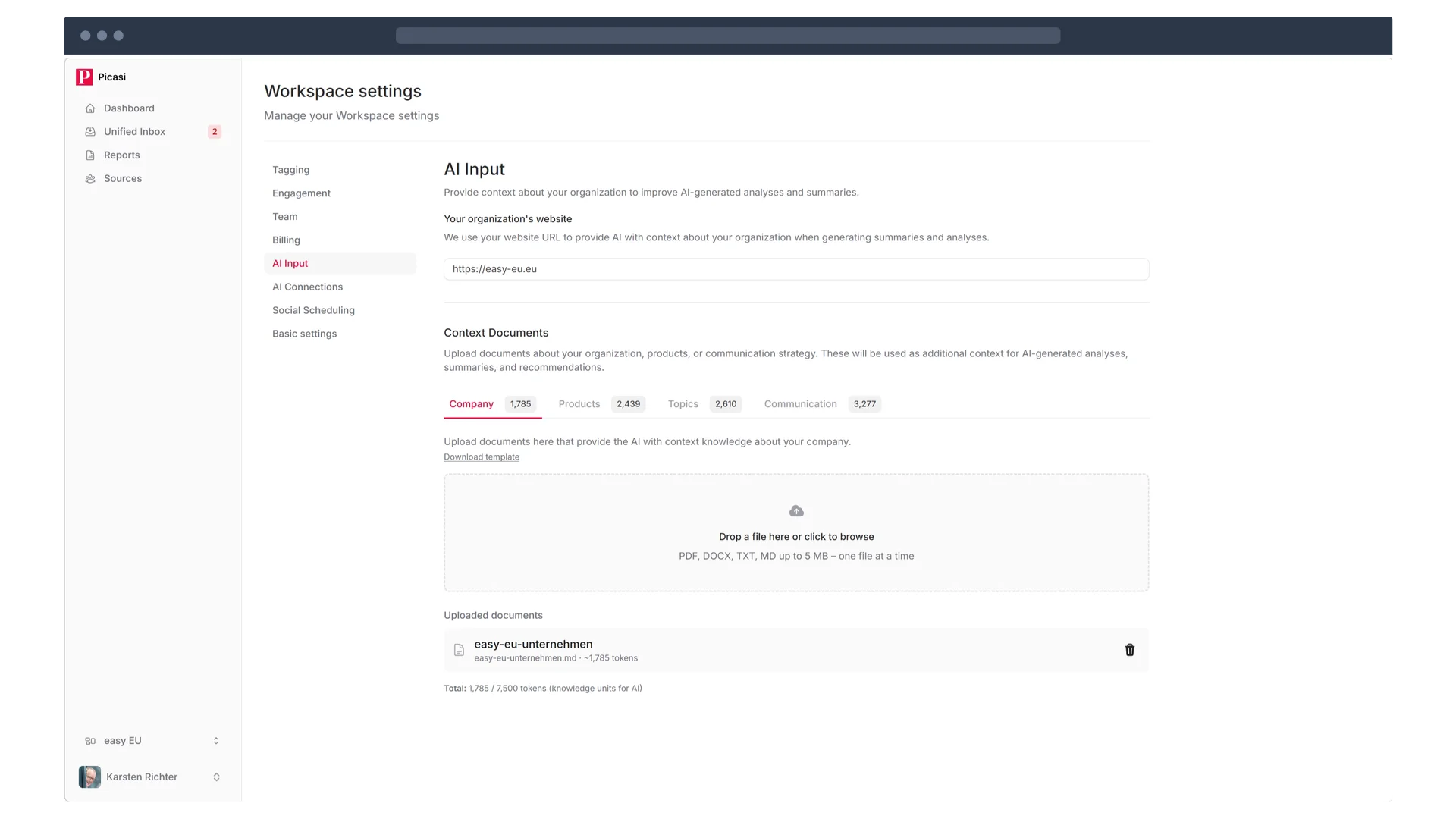
AI Context Documents are documents you store in Picasi once – product, market, positioning, communication goals. Picasi draws on them for every AI summary and every analysis. The result: evaluations tailored to your business, instead of general statements that could apply to any company.
Which problem does AI Context solve?
AI analyses without company context inevitably stay generic. A model that doesn't know what you sell and to whom can summarize a competitor announcement – but it can't judge whether that announcement concerns you. And that judgment is exactly the part that saves work.
AI Context closes that gap once and for all, instead of with every single query. You describe your company once; every later evaluation draws on it automatically. "Competitor X announced a feature" becomes "Competitor X is targeting the same segment you serve".
What can AI Context do, concretely?
- Multiple documents in parallel – typically separated into product, market/topic, and company, rather than squeezing everything into one file.
- A 30,000-token total budget across all documents, identical in every plan – no upselling via context size.
- Visible token counts per document and in total: you always see how much of the budget is used and how much remains – no silent truncation.
- Controllable ordering: documents can be prioritized when space gets tight.
- Website as context: Picasi additionally draws on your stored company URL to understand your focus.
- Team language and timezone feed in, so evaluations arrive in your language and on your rhythm.
What does AI Context deliberately not do?
It is not a document archive. The token budget is deliberately tight: it should force you to describe the essentials rather than upload manuals. More context does not produce better analyses – curated context does. Anyone hitting the limit should cut, not expand.
It is also no substitute for your source selection. The context influences how Picasi interprets the updates it collected – not which updates arrive in the first place. That is still decided by your source and channel base. The Source-First approach applies here too: Track who, not what.
How do teams set up their AI Context?
Three documents as a frame
One document on the product, one on the market and topic area, one on the company. That split covers most questions and stays within budget.
Make positioning explicit
The more clearly you state what you set yourselves apart from, the more sharply the AI recognizes when a competitor's move touches your position.
Maintain it quarterly
Positioning changes slowly, but it does change. A short review each quarter is enough to keep the context from going stale – and the analyses with it.
✓ First 300 updates free · ✓ Set up in 5 minutes · ✓ No credit card required
Frequently asked questions about AI Context
Analyses that know your business
Try Picasi with 300 free updates – AI Context with the same budget in every plan.