


The Three Approaches to Market Monitoring Compared
In short
There are three ways to watch a market, and they differ in what they filter on: Topic-First filters by topic, Source-First by sender, Platform-First by place. Each is narrow, just in a different place. None of them sees everything.
The decision that comes before all the others
Anyone selecting a market-monitoring tool usually compares features and prices. But the decision that actually determines the value is made earlier, and is rarely made consciously: what is being filtered on?
That choice determines what you will systematically never see. No amount of functionality makes up for it later, because the gap is not in the tool but in the logic in front of it.
Three filtering approaches have established themselves. They do not exclude one another, and none is superior. They answer different questions.
The map
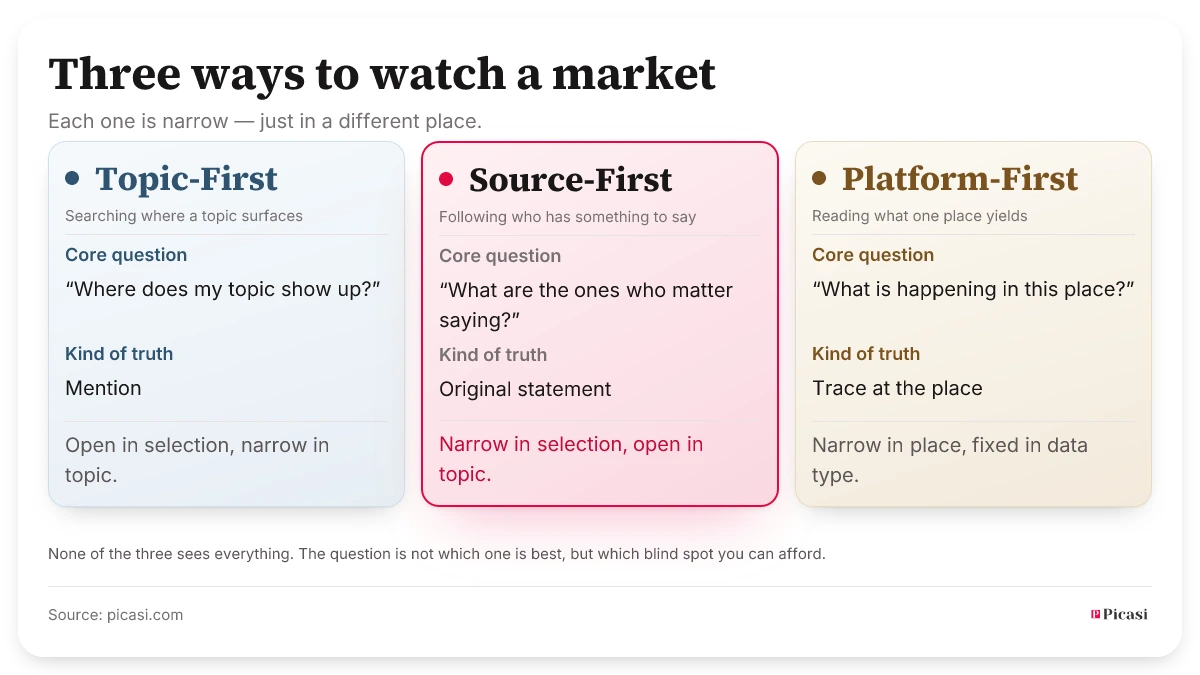
| Topic-First | Source-First | Platform-First | |
|---|---|---|---|
| Question | What? | Who? | Where? |
| Filters by | Topic | Sender | Place |
| Core question | “Where does my topic appear?” | “What are the people who matter saying?” | “What is happening in this place?” |
| Kind of truth | Mention | Original statement | Entry on the platform |
| Selection | open | narrow | open: whoever posts there |
| Topic space | closed | open | closed |
| Typical place | search index, mention feeds | the source's own channels | job boards, tender portals, registers |
| The point | Open in selection, narrow in topic. | Narrow in selection, open in topic. | Narrow in place, fixed in data type. |
None of the three sees everything. The question is not which is best, but which gap you can afford.
Topic-First: filtering by topic
You define terms, the tool reports hits, keyword and mention monitoring is the most common implementation. The filter sits on the topic; the senders emerge from it.
The genuine strength: Topic-First finds senders you do not know about. A provider that has existed for six weeks and is occupying your vocabulary turns up here, long before anyone adds it to a list of sources.
The limit: whatever your search terms do not cover does not exist. And every hit has to be interpreted, because it is unclear who is speaking and whether it counts.
In detail: Source-First vs. Topic-First.
Source-First: filtering by sender
You define the sources, competitors, opinion leaders, partners, and get everything they publish through their own channels. The filter sits on the sender; the topic stays open.
The genuine strength: you also learn the things you would never have searched for. A change of position rarely announces itself in the terms already on your list, it announces itself by someone starting to talk differently. I see this pattern over and over in conversations with CMOs: the source list was put together once during setup and nobody has touched it since, even though the market has moved on considerably.
The limit: blindness to everyone not on the list. The result is only as good as the source selection, and an outdated list produces a very tidy, wrong picture, which is worse than obvious noise.
Picasi works this way: What is Source-First Intelligence?
Platform-First: filtering by place
You pick a platform and follow every new entry of one kind, usually filtered by fixed fields such as region, sector or category rather than by keywords. A platform is a place run by a third party where many senders publish entries of the same kind: a job board, the EU tender portal TED, a company or patent register, a marketplace. A competitor’s company page on LinkedIn, by contrast, is a channel of that source; LinkedIn as a whole is a platform.
The genuine strength: completeness within the platform, including senders you do not know yet. A hypothetical example: a recruitment agency watches job boards to see which companies are looking for staff. A list of sources would only show it the companies already on that list. According to TED (Tenders Electronic Daily), more than 3,000 public procurement notices appear there every working day, searchable by country, region and sector.
The limit: a platform shows entries, not the whole market. Eurostat notes that online job ads are biased by sector and occupation, and that the same ad may be counted several times if it appears on several portals. And why a company is hiring is not in the entry; it appears, if anywhere, on the company’s own channels.
What this does not mean is analyzing reach, engagement and followers of your own social media channels. That is channel analytics, a separate task, and not an approach to market monitoring.
Which platforms are suitable, where their limits lie and what rules apply to systematic extraction is covered in detail in Market Monitoring: Topic-First, Source-First, Platform-First on source-first-intelligence.com, our website on the Source-First approach.
In detail: Source-First vs. Platform-First.
And Competitive Intelligence?
Classic Competitive Intelligence does not fit neatly into this grid, because it asks a fourth question: what is said about a company? Reports, reviews, analyst opinions, outside assessment rather than original statement.
That is not a variant of the three filtering approaches but a complement. Anyone wanting to know how a market participant is perceived from outside cannot avoid CI; none of the three approaches above answers it. The comparison in detail: Source-First vs. Competitive Intelligence.
Which approach for you
Instead of comparing feature lists, answer these three questions first:
- Can you name the market participants that matter? If so, Source-First is the strongest lever. The selection is then your advantage, not your problem.
- Does relevant material regularly come from senders you do not know? Then you need Topic-First as a net, at least alongside.
- Does your question belong to a place that already organizes it, such as who is hiring in your region, which contracts the public sector is tendering, or who is filing patents in your technical field? Then Platform-First. The platform also shows senders you do not know yet.
None of the three is built for analyzing your own posts; that is what each platform’s analytics are for. Many teams need two of them. But the combination only works with a clear division of roles, otherwise you pay twice for the same thing and still have both gaps.
The expensive mistake is not the choice
The three approaches compete less than vendor copy suggests. They cut different sections out of the same reality, and every section has an edge. The expensive mistake is not choosing the wrong approach. it is believing the chosen one is complete.
Picasi sits deliberately on the Source-First side: track who, not what. What that costs is written above, in the same row as what it delivers.
Frequently asked questions
The comparisons in detail
- Source-First vs. Topic-First, topic or sender as the filter
- Source-First vs. Platform-First, one place or one source
- Source-First vs. Competitive Intelligence, what others say about you
- What is Source-First Intelligence?, the fundamentals