


Signal vs. Noise: Identifying Relevant Competitor Updates
The Signal-to-Noise Problem
According to an analysis of 1.3 million posts on over 16,000 company pages, companies post on LinkedIn about 18 times a month on average, or 4–5 posts per week (Socialinsider, 2026). With 10 competitors, that amounts to 40–50 updates per week. But only 2–3 of them are strategically important. The rest is just noise: HR posts, event announcements, generic content pieces. The trick is to separate the signal from the noise – automatically, not manually.
What is a "signal"?
Three weeks ago, a competitor posted on LinkedIn: "We're launching Feature X for Segment Y." It sounds harmless at first, until you realize that Segment Y is exactly your core target audience. That's a signal. It's information that's strategically relevant and forces you to take action.
Not every competitor’s move deserves your attention. But what if a competitor changes its pricing and suddenly becomes 30% cheaper than you? That’s a signal. What if a U.S. competitor announces plans to expand into the DACH region? Signal. If a direct competitor repositions itself, from “We are project management software” to “We are a collaboration platform”, then that’s an opportunity for your own differentiation. That’s also a signal.
What all these updates have in common is that they change the competitive landscape. You need to respond, or at least make a conscious decision not to respond.
What is "noise"?
Noise is anything but that. A LinkedIn post like "Our team event last Friday was great! 🎉" may be likable, but it’s strategically irrelevant. The same goes for "Merry Christmas from our team!" or "Check out our latest blog post: 10 Tips for Better Productivity." These are all publicly visible updates, but they don’t change anything about your competitive situation.
Even job postings are mostly just noise. "We're looking for a Junior Marketing Manager", that doesn't interest you. But "We're looking for a Head of DACH Sales", that could be relevant because it shows that the competitor is expanding into the German-speaking market.
The line between signal and noise is sometimes blurred. But as a rule of thumb: if the update doesn't prompt you to take action or think about it, it's noise.
The signal-to-noise ratio
I recently spoke with a CMO who uses a traditional competitive intelligence tool. His problem: The tool crawls everything, news, social media, reviews, blog posts. For a keyword like “productivity,” he gets thousands of hits per week. Of those, maybe 5% are actually relevant. He spends 80% of his time filtering through noise and only 20% on actual analysis. This is not an isolated case: 37% of B2B buyers explicitly ask for less, more relevant content, and cite information overload as one of their main problems.
That’s the difference between keyword monitoring and Source-First Intelligence. Instead of crawling the entire internet, you track only relevant sources. Your main competitor’s LinkedIn CEO post. Their newsletter. Their YouTube channel. Not just any blog post where the competitor’s name is mentioned in passing.
This flips the ratio: 20% of your time goes toward filtering, and 80% toward strategic analysis. And that’s exactly what it’s all about, not more information, but better information.
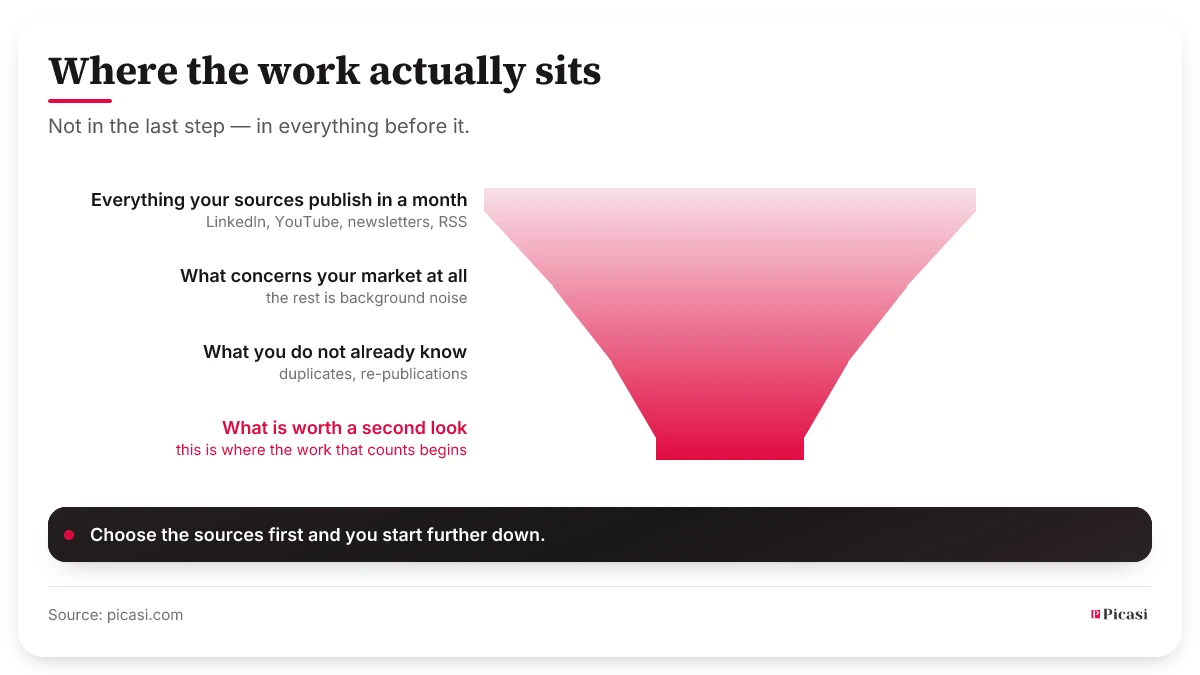
Take that apart and there are four filter steps, one after the other. At the start is everything your sources publish in a month: LinkedIn, YouTube, newsletters, RSS. Only part of it concerns your market at all; the rest is background noise. Of that part, only some is something you do not already know, duplicates and re-publications drop out here. And only what is then left is worth a second look. The work does not sit in that last step but in the three before it. Choose the sources first and you start further down.
How to Automatically Identify Signals
Keyword filters are the obvious first step. You define strategic keywords, “launch,” “pricing,” “expansion,” “Head of”, and set up notifications to alert you when they appear. It works in theory. In practice, you’ll get a ton of false positives. "Launch Event" isn’t a product launch. "Pricing Strategy Blog Post" isn’t a pricing change.
That’s why you need context-based filters. AI that understands: Is “launch” in the context of a product or an event? Is “pricing” an announcement or a general how-to article? Picasi uses exactly that, a post saying “We’re launching Feature X” is recognized as a signal, while “We’re launching our webinar on Feature X” is recognized as noise.
The difference may seem subtle, but it’s crucial. Without an understanding of context, you’ll be overwhelmed by false positives. With an understanding of context, you’ll see only what really matters.
And then there’s the source itself. Not all sources are equally valuable. A post by a CEO on LinkedIn is far more likely to be a signal than a post by HR on the company page. Why? CEOs post less frequently, and when they do, it’s usually about strategic topics. 95% of HR posts are noise (job postings, team events, employer branding content).
| Source | Signal probability |
|---|---|
| CEO/Founder LinkedIn Profiles | High (70%+) |
| Company Page (LinkedIn) | Medium (30–50%) |
| HR/Recruiting Posts | Low (5–10%) |
So your strategy should be: prioritize CEO posts, de-prioritize HR content. It sounds simple, but it makes a huge difference in the signal-to-noise ratio. LinkedIn Marketing Solutions itself documents how information overload slows down B2B decision-making processes, and why the channel matters more than the keyword.
Signal Categories: What You Should Track
Not all signals are equally urgent. Some require an immediate response, others call for strategic monitoring, and still others are simply "nice to know." It helps to define this in advance.
Tier 1 – Immediate Attention: Product launches that threaten your USP. Price changes that suddenly make you more expensive. New competitors entering your market. For these signals you should set up Competitive Alerting: push notifications, Slack alerts, or whatever else ensures that you can respond immediately.
Tier 2 – Strategic Monitoring: Messaging shifts (how are they repositioning themselves?), thought leadership (what topics are they promoting?), partnerships and integrations (ecosystem plays). These are updates you won’t want to miss, but they don’t require an immediate response.
Tier 3 – Good to Know: Funding announcements, awards, senior hires (C-level). Interesting in the bigger picture, but not a game-changer.
How this works in practice
A typical setup: You select 5–10 key competitors and track their LinkedIn Company Pages and CEO profiles. Then you set up alerts for Tier 1 signals: keywords like "launch," "pricing," "expansion," and "available," filtered contextually using AI. And you set aside 10 minutes each day to review the filtered updates.
Out of 50 updates a week, you’ll end up automatically seeing only the 2–3 that are relevant to you. No more manual scrolling. No missed signals. No information overload.
Less is more
The best competitive intelligence doesn’t collect the most data, it filters it best. That’s the difference between being “overwhelmed by information” and being “strategically informed.” It’s the difference between a tool that delivers 500 updates a week, 495 of which are irrelevant, and a tool that delivers the 5 relevant ones, and only those.
Signal-to-noise optimization isn't just a nice-to-have feature. It's at the heart of Source-First Intelligence. According to Crayon’s annual study, 58% of CI professionals struggle to gather relevant intelligence in a timely manner – not because there isn't enough data, but because there is so much irrelevant data that it makes it difficult to find the important information.