


Picasi Feature
The Unified Inbox: one stream instead of a dozen tabs
The Unified Inbox is the central place in Picasi where all updates from your monitored sources come together: LinkedIn, YouTube, newsletters, and RSS feeds – sorted chronologically, filterable by source, channel, and tag, tagged by AI. One place instead of a dozen tabs, one pass instead of a daily clicking routine.
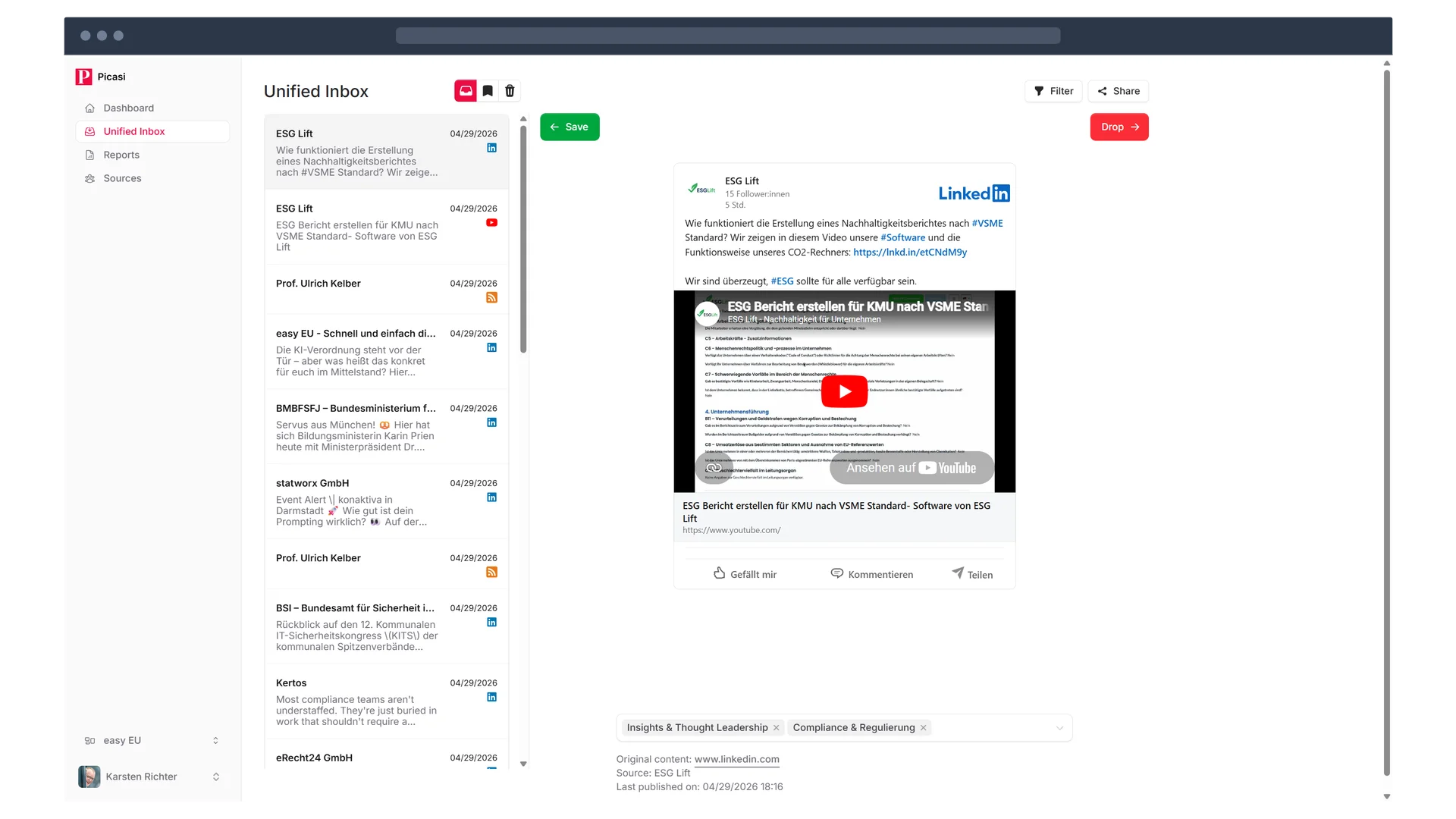
Which problem does the Unified Inbox solve?
Market monitoring rarely fails for lack of will – it fails because the signals are scattered: the relevant ones sit on LinkedIn, in a newsletter, in a YouTube video, and in a blog feed. Four places, four routines, four chances to miss something. Doing that manually costs hours per week just collecting, before any thinking starts.
The Unified Inbox removes that step. Picasi retrieves your sources' channels itself and files every update into the same stream. What remains is the actual work: interpreting, deciding, responding.
What exactly comes together here?
- LinkedIn – company pages and personal profiles: the channel where B2B announcements appear first.
- YouTube – your sources' channels: product videos, webinars, conference talks.
- Newsletters – via a forwarding address, without cluttering your own mailbox.
- RSS feeds – blogs, press releases, podcasts.
- Unlimited sources: what's capped is the number of Updates per month, not the number of your sources – so you can monitor broadly and use the channels to control how much volume arrives.
- AI tagging of every incoming update, so the stream can be filtered by topic instead of read linearly.
What does the Unified Inbox deliberately not do?
It is not a social media inbox: you read what your sources publish, but you don't reply from inside Picasi. Interaction stays where it belongs – in your own channel.
It is also not a search engine. Only what your selected sources publish on their monitored channels enters the stream. A source you don't monitor never appears – and neither does anything a monitored source says on an unsupported channel. That's the Source-First approach: Track who, not what. Signal instead of noise, because the source base is chosen deliberately.
That implies a task, not an excuse: your source and channel base should be reviewed for gaps regularly – new relevant sources, new channels of existing sources. That keeps the topical openness without letting the noise back in.
How do teams work with it?
The ten-minute morning
One pass through the stream since yesterday, tag what matters, drop the rest. What used to take an hour across four channels is now a single pass.
Knowledge that belongs to the team
Because everyone reads the same stream, market knowledge no longer depends on the one person who happens to scroll. Holidays and job changes stop leaving holes.
The basis for everything else
The same stream feeds the Matrix, the reports, and access through the MCP integration. Collected once, used many times.
✓ First 300 updates free · ✓ Set up in 5 minutes · ✓ No credit card required
Frequently asked questions about the Unified Inbox
One place instead of a dozen tabs
Try Picasi with 300 free updates – no credit card, set up in 5 minutes.