


What is Source-First Intelligence?
Brief definition
Source-First Intelligence is an approach to competitive intelligence in which marketing teams directly track their competitors' original sources, LinkedIn Company Pages, YouTube channels, newsletters, RSS feeds, rather than relying on aggregated market data or social listening tools. This approach prioritizes primary sources (what competitors say themselves) over secondary interpretations (what others say about them).
Why Source-First Instead of Data-First?
In the fall of 2023, I spoke with the CMO of a mid-sized SaaS company. His team was using three different competitive intelligence tools. None of them had alerted him to the fact that his main competitor had just launched a completely new pricing model, which had been publicly announced on LinkedIn two weeks earlier.
Traditional CI tools aggregate data from hundreds of sources, filter by keywords, and rank by sentiment. Yet they often miss the obvious: what the competitor communicates itself, on its own channels, in real time.
Source-First Intelligence flips the logic on its head. Instead of collecting data and then filtering it, you first identify the relevant sources, and track only those. Directly. Continuously. Without noise.
The Source-First Framework: Source → Signal → Insight → Sharing
Source-First Intelligence is based on a simple four-step framework:
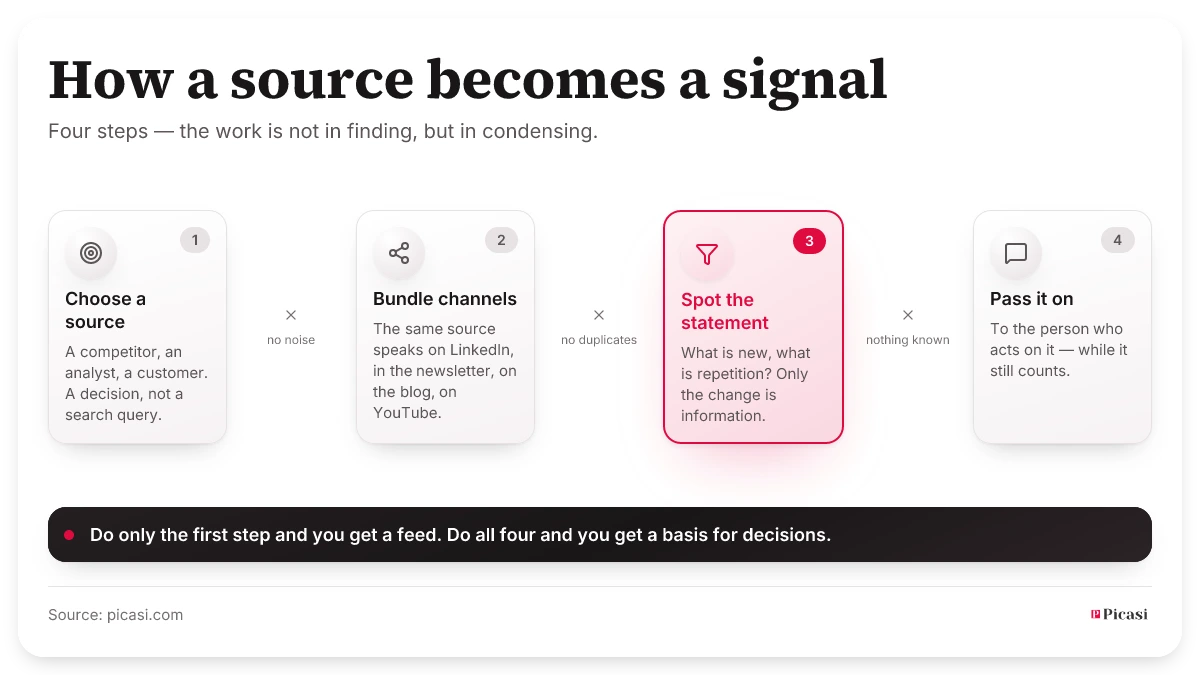
1. Define the source
Which channels does your competitor control? These typically include:
- LinkedIn Company Pages (official updates, staff posts)
- YouTube channels (Product demos, webinars, thought leadership)
- Newsletter (Email or RSS-based)
- Corporate Blogs (via RSS feed)
- Podcast feeds (Audio content, interviews)
What matters here is the difference between owned media and earned media: you want to know what competitors are actively communicating, not what journalists are writing about them. Read more in our article on Original Source Tracking.
2. Identify the signal
Not every update is relevant. Source-First Intelligence filters by strategic signals rather than noise:
- Product Launches (new features, pricing changes)
- Go-to-Market Shifts (new target audiences, positioning)
- Thought Leadership (What topics are they promoting?)
- Hiring Patterns (Who will be hired? → Strategic direction)
3. Derive insights
The signal alone is useless. The question is: What does that mean for us?
- Do we need to adjust our pricing?
- Are they targeting a new market that we should defend?
- Can we exploit their messaging weaknesses?
4. Pass it on
An insight that stays with one person changes nothing. The last step is the one most often skipped: getting the finding to whoever acts on it.
- Sales needs the pricing change in the battle card, not in an inbox
- Product needs the competitor’s new feature before the next roadmap round
- Leadership needs the market move before it turns up in a quarterly report
Do only the first step and you get a feed; do all four and you get a basis for decisions.
Source-First vs. Traditional Competitive Intelligence
Traditional CI tools (such as Crayon or Klue) work differently:
| Aspect | Source-First Intelligence | Traditional CI tools |
|---|---|---|
| Data source | Original sources (LinkedIn, YouTube, newsletter) | Aggregated data (news, reviews, social media) |
| Focus | What does the competitor say? | What do others say about the competitor? |
| Signal-to-noise ratio | High (relevant sources only) | Low (many irrelevant mentions) |
| Real-time capability | Yes (direct feed) | Delayed (Crawling, Indexing) |
| Best use | Product launches, pricing, messaging | Brand Sentiment, PR Coverage, Market Buzz |
Both approaches have their merits. But if you want to know what your competitors are planning (not what the market thinks), Source-First is the more efficient approach. You can find a detailed comparison of the two approaches in our comparison article.
Practical example: New CMO, new market
Imagine this: You’ve just started as CMO at a B2B SaaS company. New industry, new market, five main competitors. Your CEO expects a well-thought-out go-to-market strategy in 90 days.
Traditional approach: You buy a sentiment analysis tool and have it crawl all news articles, social media posts, and review sites. After two weeks, you have 2,000 mentions, but no idea what’s actually relevant.
Source-first approach: You identify the five competitors and track their:
- LinkedIn Company Pages (official updates)
- CEO/Founder Profiles (Strategic Indicators)
- YouTube Channels (Product Messaging)
- Newsletter (Sales Narrative)
After a week, you’ll have 20 relevant updates, and a clear picture of who’s targeting which markets, which features are being promoted, and which narratives are dominating.
That is Source-First Intelligence: Less data, more clarity.
When is source-first intelligence the right choice?
Source-first intelligence is particularly valuable when:
- you have a few clearly defined competitors (3–20 companies)
- these competitors communicate actively on LinkedIn, YouTube, or via newsletter
- you have to make quick strategic decisions (no time for reports)
- your team has no resources for manual research
Source-First is not a substitute for traditional CI tools if you:
- Want to track brand sentiment (what customers are saying about you)
- need to analyze PR coverage (media response)
- Conduct social listening (Twitter, Reddit, forums)
The future is source-first
Marketing decision-makers no longer have time for 50-page competitive intelligence reports that are two weeks old. They need relevant signals in real time – straight from the source. That’s exactly what Competitive Alerting is designed for.
Source-First Intelligence is the answer to this reality: less noise, more clarity, faster decisions.