


Source-First vs. Platform-First: One Place or One Source?
In short
Platform-First starts at a platform and follows every entry of one kind, such as every new job ad in a region or every tender in a sector. Source-First starts at chosen sources and follows them across all of their channels. In one sentence: Platform-First asks “where?”, Source-First asks “who?”.
Two ways of choosing the cut
Every form of market monitoring cuts a section out of reality. The interesting question is along which line the cut is made.
Platform-First cuts by place. The place is a platform: somewhere run by a third party where many senders publish entries of the same kind. Typical examples are job boards, the EU tender portal TED, company and patent registers, or marketplaces. You follow every new entry of one kind, usually filtered by fixed fields such as region, sector or category rather than by keywords. Who posts there is not decided in advance.
Source-First cuts by sender. Everything a chosen source says is in, regardless of where they say it. In exchange, everything from anyone not on the list is out.
The line between the two runs between platform and channel. A competitor’s company page on LinkedIn is a channel of that source; LinkedIn as a whole is a platform. In the same way, a company’s careers page is a channel, while a job board is a platform of many senders. How the two logics differ across three pairs (job board and careers page, tender and press release, register notice and company announcement) is shown in the comparison Source or Platform? on source-first-intelligence.com, our website on the Source-First approach.
The two approaches side by side
| Platform-First | Source-First | |
|---|---|---|
| Core question | “Where? What appears in this place?” | “Who? What is this market participant saying?” |
| Starting point | a platform and fixed fields such as region, sector, category | a list of sources with their channels |
| What you get | every entry of one kind, including from unknown senders | the content specific senders publish themselves, across all channels |
| Typical place | job boards, tender portals, registers, marketplaces | the source’s own channels: website, newsletter, LinkedIn page, YouTube channel |
| Strength | overview of a market, new names, comparable fields | context, the sender’s own account, announcements before the formal entry |
| Limit | only what is on the platform | only who is on the list |
| The point | Narrow in place, open in senders. | Narrow in selection, open in topic. |
The table is an assessment, not a measurement.
What Platform-First does better
Platform-First answers questions for which a list of sources is too short: who is hiring, tendering, filing a patent or founding a company right now. A hypothetical example: a recruitment agency watches job boards to see which companies are looking for staff. A list of sources would only show the companies already on it. The job board also shows the ones it could approach next.
Its strength is completeness within the platform, plus the fixed fields. Eurostat defines online job ads as “postings published on the internet by employers” looking for candidates with specific skills, and uses them for official statistics. According to TED (Tenders Electronic Daily), more than 3,000 public procurement notices appear there every working day, searchable by country, region and sector. And Germany’s patent office describes its free DPMAregister as “suitable for the regular and systematic checking of newly published IP rights as part of a monitoring search.”
Where Platform-First reaches its limits
A platform shows entries, not the whole market. Eurostat itself notes that online job ads are biased by sector and occupation: IT positions are more likely to be advertised online than jobs in small shops such as butchers or bakeries, or in the public sector. The same ad can appear on several portals and be counted more than once.
A platform also sorts by its own fields. If you see a new job ad from a competitor on a job board, you do not yet know why the competitor is hiring. The announcement that goes with it appears, if anywhere, on the competitor’s own channels.
Metrics analytics is a different task
Platform-First is often confused with something else: analyzing reach, engagement rate and followers on a social media platform. That is channel analytics. For your own channels it is the right tool: if you want to know whether Tuesday’s carousel did better than Thursday’s video, you need the platform’s analytics, not market monitoring. It has nothing to do with Platform-First, because it does not follow every entry of one kind, only the numbers of a single channel.
For watching others, that view is of little use. I see this in conversations with B2B CMOs again and again: a dashboard shows exactly how their own carousel performed, and the quiet on a competitor’s side quickly turns into “they must be inactive right now,” when really the competitor was just talking somewhere else.
A market participant does not communicate in one place. The announcement goes out on LinkedIn, the explanation as a YouTube video, the detail in the newsletter, the technical version on the blog. Watching only one of those channels means seeing a fragment and mistaking it for the news.
On top of that: visible metrics are becoming steadily less useful as a yardstick for someone else's communication. Across 673,658 posts from 63,108 accounts, the 2026 Metricool study found likes down 13% and comments down 17%, while actual engagement rose by roughly 14% (Metricool LinkedIn Study 2026). Interaction is moving into clicks, carousel swipes and video views that stay invisible from outside.
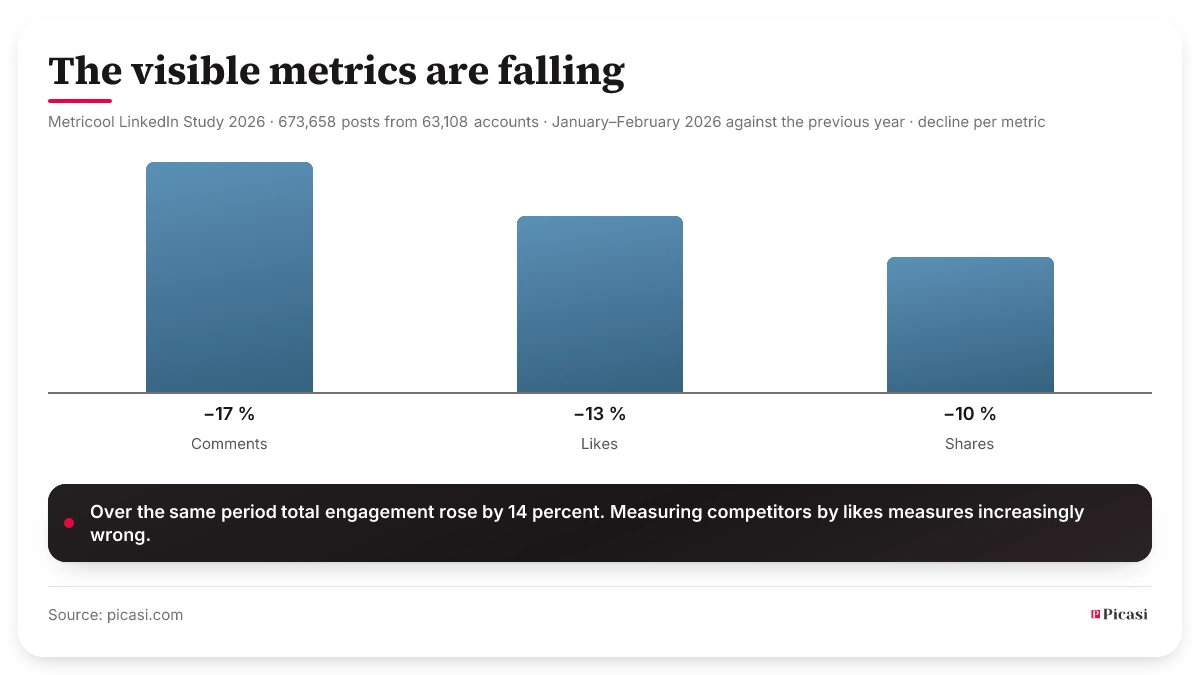
Concretely: judging a competitor by their like counts means watching a number fall while the impact rises. Publicly visible figures now systematically understate other people's communication. What a market participant says, by contrast, remains meaningful; it does not depend on how a platform happens to measure it.
The price Source-First pays
The limit belongs here too: Source-First provides no metrics about other people's content. We show what a source published and when, not how many people saw it. Anyone needing a defensible reach figure for a competitor will not get it from us, and honestly barely anywhere else, because that data belongs to the platforms and the account holders.
The second limit is the list itself. Whoever is not on it is missing: a company posting jobs for the first time shows up on the job board, but only appears in your list of sources once someone adds it. And a source shows only what it wants to say. Both limits are structural, not stages of development.
Which approach when
- You want to know who is hiring in a region right now, which contracts the public sector is putting out to tender, or who is filing patents in a technical field: Platform-First. The platform already organizes that question, including for senders you do not know yet.
- You want to know what specific competitors, customers or associations are saying and planning: Source-First. Their own channels also show what never appears on a platform.
- You want to know how your own posts are performing: neither. That is what each platform’s analytics are for.
How Picasi brings a source's channels together is on the Unified Inbox page; how trends can be read from that, on the Matrix page.
The platform finds, the source tells
Platform-First and Source-First compete less than it appears. They combine in a simple sequence: the platform shows a new sender, such as a company hiring in your region or a contracting authority tendering for the first time. That sender goes on your list of sources, and from then on you follow it on its own channels. Writing in Harvard Business Review, Wei Shi calls the jobs a competitor is trying to fill “one of the clearest and most accessible signals of strategic intent”. If you follow the competitor as a source, you read that signal alongside everything else it says.
Picasi starts at the sources, track who, not what. The third direction compared: Source-First vs. Topic-First.
Frequently asked questions
See also
- The three approaches to market monitoring, the overview of all three ways
- Source-First vs. Topic-First, topic or sender as the filter
- Source-First vs. Competitive Intelligence, what others say about you
- LinkedIn KPIs in B2B marketing, which metrics still hold up