


Source-First Intelligence vs. Competitive Intelligence
TL;DR: The main difference
Source-First Intelligence tracks the original sources of your competitors (LinkedIn, YouTube, newsletters). Competitive Intelligence Tools aggregate data about your competitors (news, social media, reviews). The difference: Source-First shows what competitors say themselves. CI shows what others say about them. Both have their place, but for different use cases.
The two approaches side by side
Both work with the same building blocks: there are speakers, and there is what gets said. The difference lies in whose statements are captured.
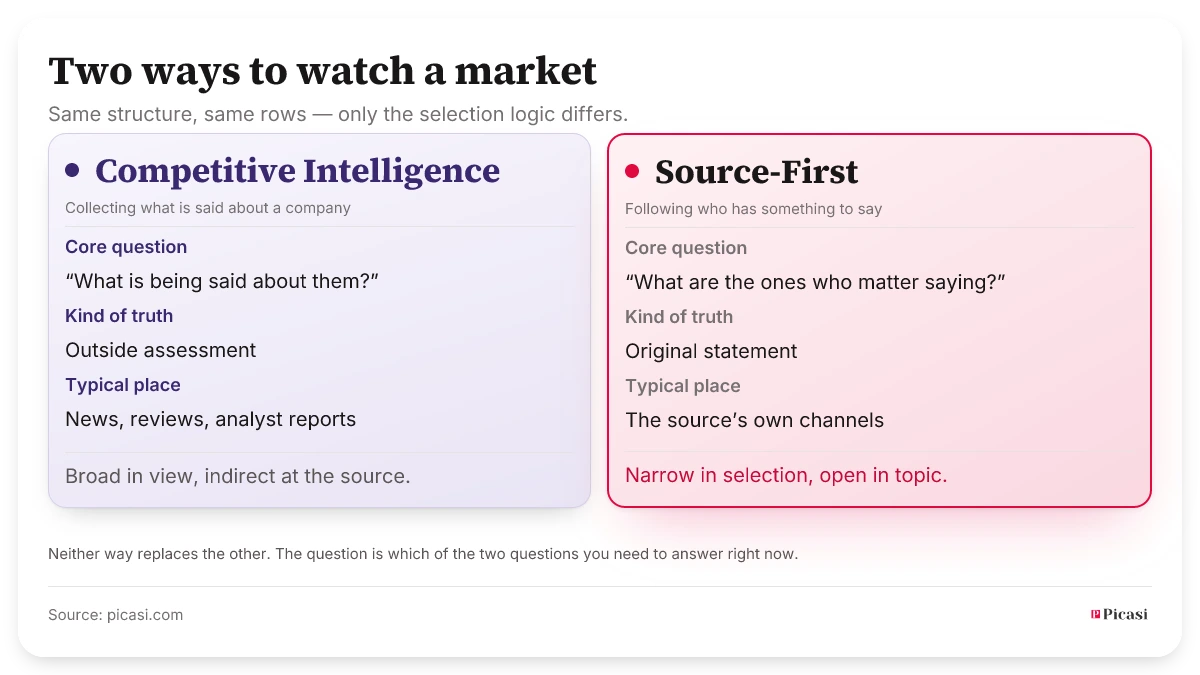
| Competitive Intelligence | Source-First | |
|---|---|---|
| Core question | “What is being said about them?” | “What are the people who matter saying?” |
| Kind of truth | Outside assessment | Original statement |
| Topic space | open | open |
| Typical place | news, reviews, analyst reports | the source's own channels |
| The point | Broad in view, indirect at the source. | Narrow in selection, open in topic. |
The strength of Competitive Intelligence is in the left column, and it is real: you learn how a company is seen from outside, by journalists, analysts, customers. Source-First does not ask that question at all. Conversely, Source-First shows the statement verbatim and without delay, but only from senders you chose yourself.
The same comparison exists for the other two directions of market monitoring: against Topic-First and against Platform-First. All three together: the three approaches to market monitoring.
The Origin of the Difference
Competitive intelligence is not a new field. For decades, companies have been analyzing their competitors: using manual research, analyst reports, and later software such as Crayon or Klue.
These tools were designed for a time when companies primarily relied on traditional media communicated through: press releases, print ads, trade show appearances. CI tools crawled news sites, collected mentions, and analyzed sentiment.
But marketing has changed radically: B2B companies now communicate directly on LinkedIn, YouTube, in newsletters. They publish thought leadership content, announce product launches, and share their strategy: publicly, continuously, and unfiltered.
Source-First Intelligence responds to this reality: Why wait for a journalist to write about a competitor when that competitor has already communicated the news themselves, two weeks earlier?
I see this in almost every conversation with marketing teams: they have a CI tool in place that dutifully delivers sentiment reports, and still find out about a competitor's price change only when a customer asks about it.
The Big Comparison: 7 Dimensions
1. Data Source: Primary vs. Secondary
Source-First Intelligence:
Primary sources – LinkedIn Company Pages, CEO profiles, YouTube channels, newsletters, RSS feeds. Anything that the competitor controls and publishes themselves.
Competitive Intelligence:
Secondary sources – news articles, social media mentions, review sites, analyst reports. Anything others say about the competitor.
In summary: Primary sources provide unfiltered strategic signals. Secondary sources reflect market perception.
2. Real-time capability
Source-First Intelligence:
In real time. A competitor posts a LinkedIn update → You see it immediately (via RSS/API).
Competitive Intelligence:
Delayed. News crawlers take hours or even days. Reports are generated weekly or monthly.
If you need to respond quickly (for example, to pricing changes), Source-First is the better option.
3. Signal-to-noise ratio
Source-First Intelligence:
High. You track only 3–20 defined sources. Every update is potentially relevant.
Competitive Intelligence:
Low. With keyword-based monitoring, you’ll get thousands of irrelevant mentions (“Apple” as the fruit vs. the company).
Source-First drastically reduces noise. CI requires intensive filtering.
4. Context and Completeness
Source-First Intelligence:
Full context. You can view the original LinkedIn post, the full YouTube video, and the entire newsletter.
Competitive Intelligence:
Fragmented. You see a quote in a news article, but not the original context.
Context is crucial for strategic interpretation. Source-First provides it.
5. Costs and Complexity
Source-First Intelligence:
Low cost. RSS/API feeds are mostly free. Tools are more affordable (less data to crawl).
Competitive Intelligence:
High costs. Enterprise CI tools cost $10,000–$50,000 per year. On top of that, there are analyst resources.
Source-First is much more accessible for small and medium-sized teams.
6. Use Case: What is it best suited for?
Source-First Intelligence is ideal for:
- Track product launches
- Identify pricing changes
- Understanding Shifts in Messaging and Positioning
- Analyzing hiring patterns (who is hiring for which roles?)
- Monitor thought leadership (what topics are they promoting?)
Competitive intelligence is ideal for:
- Measuring brand sentiment (What does the market think of us?)
- Analyze PR coverage (which media outlets are reporting on it?)
- Aggregate customer reviews (G2, Capterra, TrustPilot)
- Identify market trends (industry reports, analyst opinions)
7. Team Size and Resources
Source-First Intelligence:
Ideal for small to medium-sized teams (1–10 marketers). Automation reduces manual effort.
Competitive Intelligence:
Requires dedicated analyst resources. Ideal for large marketing teams (10+ people) with a budget.
The Decision Matrix: Which Approach Is Right for You?
| Your situation | Recommendation |
|---|---|
| You have 3–20 clearly defined competitors | → Source-First Intelligence |
| You are observing a fragmented industry (with over 100 players) | → Competitive Intelligence |
| You need to respond quickly to pricing changes | → Source-First Intelligence |
| You want to measure brand sentiment | → Competitive Intelligence |
| Your competitors are active on LinkedIn and YouTube | → Source-First Intelligence |
| Your competitors communicate solely through PR | → Competitive Intelligence |
| Your marketing team is small (<10 people) | → Source-First Intelligence |
| You have dedicated market intelligence analysts | → Competitive Intelligence (or both) |
Complementary, not exclusive
The most common mistake: assuming that you have to choose. In reality, source-first intelligence and competitive intelligence are complementary:
- Source-First for Strategic Competitor Intelligence (What are they planning?)
- CI Tools for Market Perception (What does the market think of us?)
A typical setup for a medium-sized B2B company:
- Source-First Tool (e.g., Picasi) for 5–10 main competitors → daily updates
- CI Tool (e.g., Crayon) for brand monitoring → monthly reports
- G2/Capterra for Customer Reviews → Quarterly Analysis
Every tool has its role. Source-First is not a substitute for CI, it is a supplement for more direct, faster competitor intelligence.
Finding the right balance
If you have one question after reading this article, it should be this: What is your primary goal?
- Anticipate competitors' moves? → Source-First
- Want to understand market sentiment? → CI Tools
- Both? → A combination of both approaches
For most B2B marketing teams, the answer is: Start with Source-First, and add CI as needed.