


Original Source Tracking: Go directly to the source
What is Original Source Tracking?
Original Source Tracking means monitoring the channels your competitors control themselves: LinkedIn Company Pages, CEO profiles, YouTube channels, newsletters, corporate blogs. Instead of waiting for news articles or social media mentions, go straight to the source, and get unfiltered, up-to-date information in real time.
The Telephone Game Problem
Do you remember the children's game "Chinese whispers"? One person whispers a message, which is then passed from person to person. By the end, the result is something completely different from what was originally said.
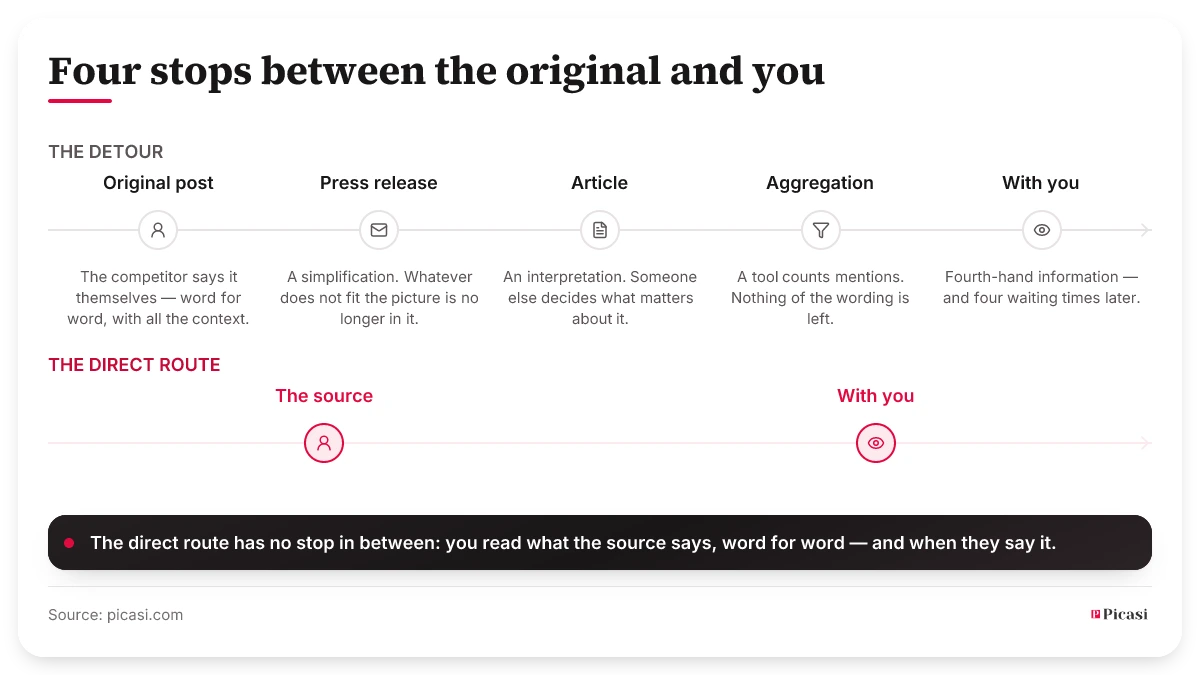
That's exactly what happens in traditional Competitive Intelligence: your competitor launches a new feature, the original. The PR team writes a press release, a simplification. A journalist writes an article, an interpretation. A CI tool crawls that article and aggregates it. By the time you read the report, you're looking at fourth-hand information.
Four intermediate steps sit between the original and you. Each one adds latency, strips away context, and risks misunderstanding. Original Source Tracking eliminates these steps: competitors → you.
I've had this conversation with plenty of CMOs in B2B, and one frustration comes up again and again: they find out about a major competitor move only once a journalist has already written it up, when the announcement had been sitting on LinkedIn for weeks.
What counts as an "original source"?
An original source is any channel a company directly controls and publishes on publicly:
Owned Media Channels
- LinkedIn Company Pages: official updates, product launches, thought leadership, hiring announcements
- Executive profiles on LinkedIn or Twitter/X: CEO, founder, CMO, often more personal, strategic signals
- YouTube channels: product demos, webinar recordings, customer success stories
- Newsletters: email newsletters or RSS-based content feeds
- Corporate blogs: trackable via RSS feed, often with deeper technical insights
- Podcast feeds: interviews and thought leadership in audio format
What does NOT count as an original source
- News articles (TechCrunch, Handelsblatt, etc.) → secondary source
- Social media mentions by third parties → earned media
- Review sites (G2, Capterra) → user-generated content
- Analyst reports (Gartner, Forrester) → tertiary source
The rule is simple: if the competitor clicks the "publish" button, it's an original source. If someone else writes about it, it isn't.
Why Original Sources Are Superior
1. Speed: days instead of weeks
Harvard Business Review describes how GenAI makes it possible to extract strategically relevant insights from publicly available competitor documents, but only if those documents are actually captured in the first place. The first step is always direct access to the source. A concrete example:
A B2B SaaS company announces a new pricing model. The CEO posts about it on LinkedIn on day 0, the original source. The PR team pitches journalists between day 3 and day 7. The first article appears between day 10 and day 14. A traditional CI tool indexes that article at the earliest between day 20 and day 30.
With Original Source Tracking, you see the announcement on day 0; with traditional Competitive Intelligence, only 20 to 30 days later. That head start can be decisive, especially if you need to adjust your own pricing.
2. Context: complete information instead of snippets
A news article about a competitor runs around 300 words. The original LinkedIn post plus its linked landing page? 2,000 words, complete with screenshots, pricing details, and use cases. Original sources deliver full context, not highlights curated by journalists.
3. Strategic signals: what they DON'T say
Original Source Tracking shows not only what competitors communicate, but also how the pattern behind it shifts. Which topics are suddenly getting pushed? Are taglines or positioning changing? Are they posting noticeably more often, often a sign of an upcoming launch phase? Or are they hiring five sales reps in the DACH region, usually a sign of expansion? These meta-signals stay invisible in aggregated CI reports.
How to Implement Original Source Tracking
The manual approach (works, but isn't scalable)
For LinkedIn, you follow competitors' company pages plus their key executives, except the feed is algorithm-driven, so you still miss posts. For YouTube, you subscribe to competitors' channels, but notifications are notoriously unreliable. Newsletters can be subscribed to with a separate email address, though that quickly leads to inbox overload with no filtering. RSS feeds via Feedly or Inoreader work reliably for blogs, just not for LinkedIn or YouTube.
Doing this manually is feasible for one to three competitors. Beyond five, it stops scaling.
The professional approach (automated, intelligently filtered)
Visualping lists 27 CI sources worth monitoring systematically, the most valuable ones are, almost without exception, direct channels controlled by the company itself. Specialized Source-First Intelligence tools (such as Picasi) automate the process:
- A central dashboard for all sources: LinkedIn, YouTube, newsletters, RSS
- Smart filtering that shows only relevant updates instead of spam posts
- Alerts for significant changes like pricing or product launches
- A historical archive that shows what was communicated six months ago
Practical example: M&A integration
A medium-sized company acquires a competitor. Suddenly, the marketing team has to keep an eye on both brands plus three other competitors.
Without Original Source Tracking, this is what it looks like: five people manually check LinkedIn and YouTube, there are weekly sync meetings to share updates, the effort adds up to more than 20 hours a week, and important posts still slip through thanks to the LinkedIn algorithm.
With Original Source Tracking, all five brands flow into one dashboard, updates aggregate automatically, a daily review takes 10 minutes, and an alert on major launches enables an immediate response. In numbers, that's a 95% time saving and 0% missed updates.
The Limitations of Original Source Tracking
Original Source Tracking isn't suitable for everything. It only works if your competitors actively communicate on LinkedIn, YouTube, or via newsletter, if you have clearly defined competitors rather than 200 unknown players to track, and if you want strategic intelligence rather than brand sentiment.
For some tasks, you'll need other tools:
- Sentiment analysis, for that, you need social listening
- Customer reviews: use G2, Capterra, or TrustPilot
- PR coverage tracking, news monitoring stays relevant here
Closer to the truth
Original Source Tracking is the most efficient form of Competitive Intelligence for one simple question: what is the competitor doing right now? Instead of waiting for interpretations, you go straight to the source: faster, more complete, more accurate.