


The Best Competitor Monitoring Tools for B2B Marketing Teams (2026)
This comparison sorts nine competitor monitoring tools for B2B marketing teams – not by feature count, but by the decision underneath: what does the tool filter on in the first place? On the topic, on the sender or on the place? That choice is made before the first alert arrives, and it determines what you will never get to see.
As of August 2026 · Independently researched based on publicly available product and review data. The price figures are from June 2026 and were not re-collected for this revision; the figures for the most recently added provider are from August 2026. Published by Picasi – we name the strengths and limits of every tool, explicitly including our own.
I have tried out all nine tools myself or worked through their publicly available information and demo environments. The most striking thing was how differently long onboarding took – from a few minutes to a sales process spanning several weeks.
The question that comes before picking a tool
Market monitoring tools differ less in what they can do than in what they filter on. Three logics have established themselves, and because vendor copy rarely names them as such, here they are in plain terms:
- Topic-First filters by topic. You set the terms, the tool reports hits from across the web. Who is speaking only emerges afterwards.
- Source-First filters by sender. You set the sources and get everything they publish through their own channels – on every topic.
- Platform-First filters by place. You pick a platform where many senders publish entries of the same kind, such as a job board, a tender portal or a register, and get every new entry, usually filtered by fixed fields such as region or sector. Who posts there is not decided in advance.
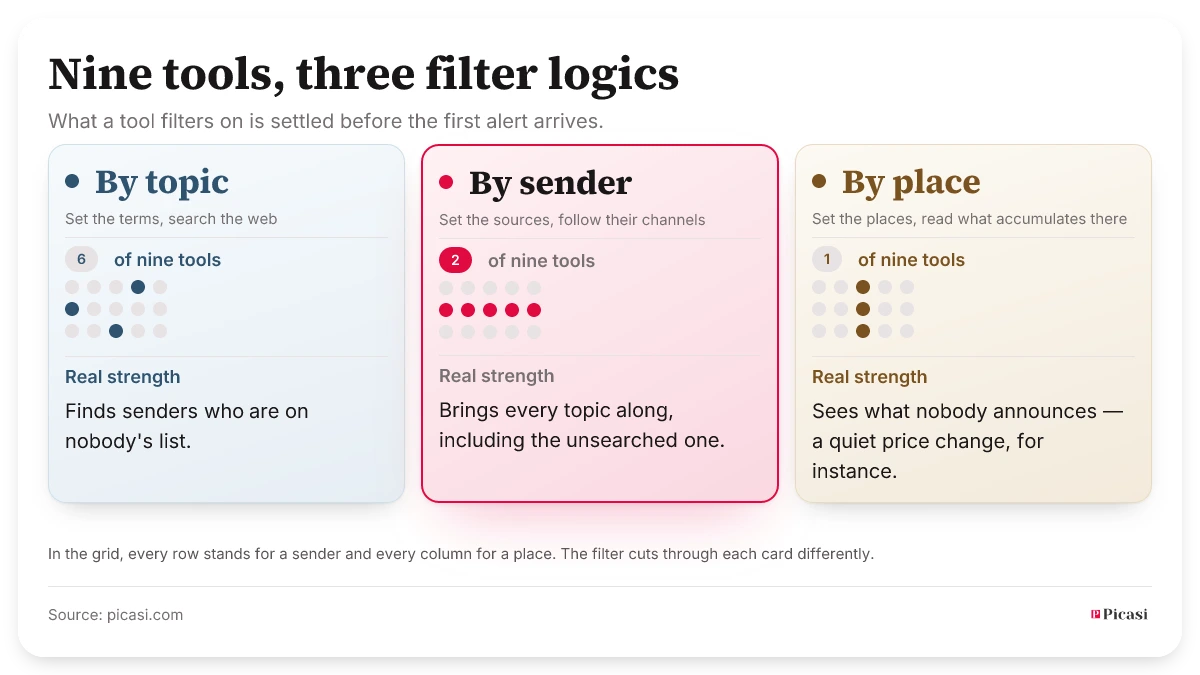
None of the three sees everything; each is narrow in a different spot. So the useful question is not which one is best, but which blind spot you can afford. The long version is in the map of the three approaches; for this comparison it is enough to sort the tools by it.
Overview: the tools in a direct comparison
| Tool | Filters by | Source focus | Target audience | Entry-level price | Transparent pricing? |
|---|---|---|---|---|---|
| Picasi | Sender Source-First Intelligence | LinkedIn (profiles + pages), YouTube, newsletters, RSS | B2B marketing, legal & compliance teams (SMB) | €199/month | ✓ open |
| Brand24 | Topic Social Listening | Social, news, blogs, forums | SMB, brand monitoring | from ~$79/month | ✓ open |
| Mention | Topic Social Listening | Social, news, web | Growing teams | from ~$41/month | ✓ open |
| Awario | Topic Social Listening | Social, news, web | Budget-conscious teams | from ~$29/month | ✓ open |
| Meltwater | Topic Media Intelligence | News, print, broadcast, social, PR | Enterprise / PR | on request (Enterprise) | ✗ sales call |
| Brandwatch | Topic Social/Consumer Intelligence | Social, web, forums | Enterprise | on request (Enterprise) | ✗ sales call |
| Feedly | Sender RSS aggregation, one channel type only | RSS, blogs, news | Individuals / research | from ~$8/month | ✓ open |
| Google Alerts | Topic Keyword alerts | News, web | Entry level / free | free | ✓ open |
| IndustryLens | Place Competitive Intelligence | Review portals, pricing pages, changelogs, ads, job postings | B2B SaaS teams | from €59/month | ✓ open |
Six of the nine tools filter by topic, two by sender, one by place. The distribution is lopsided, and it says more about the market than about the approaches: the topic filter is the longest-established one, which is why it has the most providers.
Prices and features change, and several providers have recently rebuilt their self-service tiers. The figures given here are based on publicly available information from June 2026 – for the most recently added provider from August 2026 – and should be verified with the respective provider before making a purchase decision.
What matters when choosing
The filter is the most important difference – and the only one no feature set makes up for later. Tools that filter by topic show what others say about a market. In doing so they also find senders you do not know, and that is a genuine strength the sender filter structurally lacks: a provider that has existed for six weeks and is occupying your vocabulary appears on no source list, because nobody has entered it. Tools that filter by sender, in return, show what market participants communicate themselves, on every topic – including the one you would never have searched for.
Classic tools are strong in news, press and public social. For B2B, however, competitors' LinkedIn profiles and pages, newsletters and YouTube channels are often the more relevant sources – and that is exactly where many tools are weak.
Enterprise suites offer maximum coverage but are expensive and complex. Small B2B teams usually need less reach, but fast self-service and a clear workflow.
Some providers publish their prices; others require a sales call and often land in the high four- to five-figure annual range. Transparent pricing makes selection easier for SMBs.
For teams in the EU, it also matters where data is processed and whether only publicly accessible information is used. And finally, what counts is how quickly a team is productive – and whether updates are automatically summarized, prioritized and integrated into existing AI tools.
What the place filter delivers – and what sets platform analytics apart from it
With the place filter, the platform comes first, not the sender. A platform is a place run by a third party where many senders publish entries of the same kind: a job board, a review site, an ad library. Following every new entry of one kind there also shows you senders you did not know. A competitor’s pricing page or changelog, by contrast, is not a platform but a channel of that source.
The tool in the table that we filed under place is therefore a hybrid. It reads platforms such as review sites, ad libraries and job ads, plus pricing pages and changelogs, which are channels of the companies being watched. We list it under place because it starts from the kind of place: for the companies you watch, it reads particular places, not everything they publish. Its strength lies in what structurally accumulates there: a price change shows up on the pricing page even if nobody announces it. The limit is the same property seen from the other side: whatever does not appear at any of the chosen places does not exist for this tool.
Not in the table are the platforms’ own analytics, LinkedIn analytics and YouTube Studio. They are not Platform-First, even if the name suggests it: they do not follow every entry of one kind, they measure your own channels. Whoever opens them gets a measurement depth no other tool can match: impressions, dwell time, audience breakdown. That data is created where the content is served and nowhere else. For analyzing your own work, that is the right route.
When observing others, the advantage reverses. A market participant does not communicate in one place: the announcement runs on LinkedIn, the explanation as a video, the detail in the newsletter. Anyone watching only one channel sees a fragment and takes it for the news. On top of that, the externally visible metrics are becoming ever less useful as a yardstick – across 673,658 posts, the Metricool study 2026 found likes down 13 percent and comments down 17 percent, while actual interaction rose by about 14 percent (Metricool LinkedIn Study 2026). Anyone measuring a competitor by their like counts sees a metric fall while the effect is rising.
That is why channel analytics is not in the table: it would not be an alternative to the nine, but a tool for a different task. How Platform-First and Source-First actually differ is shown in the comparison Source-First vs. Platform-First.
The tools in detail
Picasi, filtering by sender, across all channels
Picasi does not track keywords but the sources a team selects: LinkedIn profiles and company pages, YouTube channels, newsletters and RSS feeds. New updates are AI-tagged, summarized and prioritized in a Unified Inbox; entry-level pricing is transparent at €199/month, EU-hosted, and set up in minutes without a sales call. What is missing, is missing on purpose: Picasi does no web-wide keyword monitoring and keeps no press or journalist database. Anyone who needs to notice that a previously unknown provider is occupying their vocabulary needs a tool with a topic filter alongside – and anyone who needs broad media or reputation monitoring is better served by a media intelligence suite. A full overview of Picasi's features is available on the features page.
Brand24, affordable social listening
Brand24 tracks mentions across social media, news, blogs and forums, including sentiment and share of voice, at a price that is attractive for SMBs. The filter here sits on the topic, not on the sender: anyone who wants to follow ten specific competitors has to rebuild that from search terms and gets hits that still need sorting. History is limited depending on the plan, and the focus is more on brand monitoring than on targeted competitor observation.
Mention, a balance of reach and price
Mention positions itself between the affordable entry of Brand24 and the depth of enterprise tools, offering solid real-time monitoring with decent analytics. Here too the keyword decides what arrives; the tool is not built for pure source tracking, and it is not enough for deep enterprise analyses.
Awario, a low-cost entry to mention monitoring
Awario is an affordable option for social and web mention tracking, making it interesting for budget-conscious teams. It is the same filter logic as Brand24 and Mention, implemented more leanly: feature scope and analytical depth stay behind the larger providers.
Meltwater, enterprise media intelligence
Meltwater offers the broadest media coverage (news, print, broadcast, social) plus a PR suite and journalist database – the reference for large PR and comms teams. The filter sits on the topic, but through its press analysis the tool also covers a fourth question: what is being reported about a company? In return, prices are opaque and, according to publicly cited data, often in the five-figure annual range, a sales call is required, and the learning curve is steep for small teams.
Brandwatch, enterprise social/consumer intelligence
Brandwatch is strong in deep social and consumer analysis with balanced sentiment evaluation and extensive dashboards. Here too the topic filter leads to an outside view: what does the market think of a brand? Enterprise price level and complexity usually make the tool oversized for a lean B2B marketing team.
Feedly, source aggregation via RSS (+ AI "Leo")
Feedly bundles RSS sources, blogs and news and can filter via the AI assistant "Leo" – affordable and good for structured research of your own. The filter logic is the same as Picasi's: you choose the sources, not the terms. Only it is limited to a single channel type. LinkedIn pages, newsletters and YouTube channels stay outside, and there is no competitor workflow – more of an intelligent reader than an intelligence tool.
Google Alerts, free, but limited
Google Alerts delivers free keyword notifications on news and websites and is the topic filter in its simplest form. LinkedIn, YouTube and newsletters are missing, it is noisy, and nothing is summarized or prioritized. As a free net for senders you do not yet know, it remains useful all the same.
IndustryLens, filtering by place, across many places
IndustryLens is the only tool in this comparison that filters by place: for selected competitors it queries fixed places – pricing pages, changelogs, ad libraries, review portals such as G2 or Trustpilot, job postings, news – and out of that comes a weekly summary in which every statement points back to where it was found. Entry starts at €59/month and can be viewed without booking a demo, which is the exception in this class of tool. Its strength is what accumulates at a place structurally, without anyone communicating it: a quiet price change stands on the pricing page before anyone talks about it. Its limit is the same property in reverse – what appears at none of the queried places does not arrive. A competitor who explains a repositioning first in a LinkedIn post and a conference video, and only months later on the pricing page, cannot be spotted early through the places.
Which tool fits whom?
- You can name the market participants that matter and want to follow their LinkedIn, newsletter and YouTube channels completely – transparently priced, EU-hosted and ready in minutes: Picasi.
- What matters regularly comes from senders you do not know: Brand24, Mention or Awario, with Google Alerts as a free entry point.
- Broad media coverage including PR work and journalist contacts: Meltwater or Brandwatch.
- RSS only, but cheap and tidy: Feedly.
- Analyzing your own content: none of the nine – the analytics functions of the respective platform are the right tool for that.
So there is not one "best" tool, but the one that fits the question you want answered. Many teams need two of them: one with a sender filter for the market participants they can name, one with a topic filter as a net for everything else. That only works with a clear division of roles, though – otherwise you pay twice for the same thing and still have both blind spots.